Everybody wants sustainable exhibitions. So why is it still so difficult?
Everyone wants more sustainable exhibitions but many organisations still struggle to make them a reality. The biggest barriers aren’t materials or technology; they’re the decisions made long before a booth is built.
Discover why sustainable exhibition design starts with asking better questions.
Author:
Simon Davenport, Global Head of Environments & Exhibitions, Emota
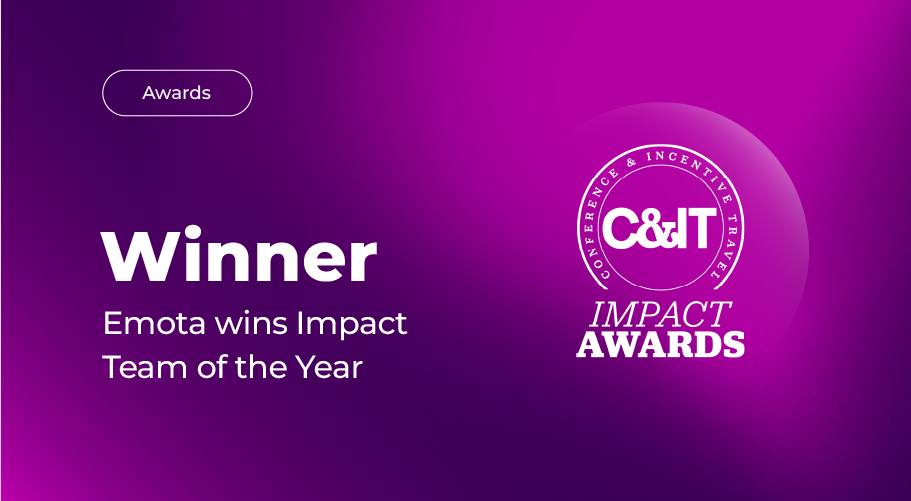
Recently, our Global Exhibitions & Environments Team was named Impact Team of the Year at the C&IT Impact Awards.
It’s an achievement I’m incredibly proud of, not because of the trophy itself, but because of what it represents. The award recognises years of hard work from a group of people who have consistently challenged convention, tested new ideas and pushed for better ways of delivering exhibitions.
What makes me proudest, though, is that none of this was ever mandated.
There wasn’t a moment where somebody handed down a strategy and told the team what to do. It started much more simply than that. People cared. They asked questions. They challenged assumptions. They wanted to find better ways of doing things.
And that got me thinking about one of the conversations I’ve had countless times over the last few years.
Everybody wants more sustainable exhibitions.
Clients want them. Agencies want them. Suppliers want them. Congress organisers want them.
The ambition is there. The intent is there.
So why does it still feel so difficult?
One of the biggest challenges, in my view, is that sustainability is often treated as something separate from the project itself. It becomes a conversation about materials, carbon emissions or waste once a design has already been developed and key decisions have already been made.
At that point, you’re often trying to improve decisions rather than shape them.
That’s why so many sustainability conversations end up focusing on what I would call cosmetic change. A material gets swapped out. A process gets tweaked. A sustainability message gets added. None of those things are bad. In fact, they’re often positive steps. But they don’t necessarily address the decisions that have the greatest influence on a project’s overall impact.
The biggest opportunities sit much earlier.
They happen during those first conversations when ideas are still being developed and nothing has been locked in. Before anything has been built. Before materials have been selected. Before logistics have been planned.
That’s where the most important decisions are made.
Another misconception I still come across is the idea that sustainability somehow limits creativity.
I understand why people think that. Sustainability is often seen as an additional requirement, another box to tick or another constraint to work around.
What I’ve seen over the years is almost the opposite.
Some of the most interesting solutions come from asking different questions. Can something be reused? Can it be adapted? Is there a smarter way of achieving the same objective? Those conversations don’t restrict creativity. More often than not, they force you to think differently, and that’s usually where the best ideas come from.
I think that’s one of the reasons this approach has gained momentum with clients. It hasn’t been about sustainability for sustainability’s sake. It’s been about finding better solutions.
Better operationally.
Better commercially.
Better environmentally.
And ultimately, better experiences for the people walking onto the exhibition floor.
What’s been particularly encouraging is seeing the conversation evolve. A few years ago, most discussions were focused on individual projects. Increasingly, clients are looking at sustainability across entire exhibition programmes and asking bigger questions.
How can assets be reused across multiple events?
How can waste be reduced year after year?
How can better decisions become part of the process rather than something that’s revisited every time a new project begins?
Those are much more powerful conversations because that’s where meaningful change starts to happen at scale.
The encouraging thing is that we’re now seeing evidence that this works.
We’re seeing reduced waste.
We’re seeing lower carbon emissions.
We’re seeing increased material reuse.
But we’re also seeing something equally important. We’re seeing more organisations adopt these approaches because they recognise the wider value they create. Sustainability is no longer being viewed solely as a responsibility. It’s increasingly being recognised as a driver of smarter design, greater efficiency and better outcomes.
Looking back, that’s probably what makes the recent award so meaningful.
It wasn’t recognition of a single project or campaign. It was recognition of a team that kept asking questions, kept experimenting and kept looking for better solutions long before sustainability became the conversation it is today.
The simple answer to where innovation comes from is the people involved.
Their passion.
Their curiosity.
Their willingness to challenge assumptions.
Their determination to keep improving.
That’s what has driven every step forward we’ve made.
The reality is that our industry can’t continue operating exactly as it always has. Most people recognise that now. The encouraging thing is that we’re starting to see genuine momentum. Clients are asking different questions. Suppliers are innovating. Congress organisers are paying attention.
Nobody is pretending the work is finished. It isn’t.
But it does feel like we’re moving beyond talking about change and starting to deliver it.
One thing I do know is that the people working in this industry care. I see it in our clients, our suppliers, our partners and, of course, in our own team. The willingness to challenge old ways of working and find better solutions is stronger today than it has ever been.
That’s why I’m optimistic.
There is still plenty of work to do, but it feels like we’re moving in the right direction.
And if our recent Impact Team of the Year win recognises anything, I hope it’s that genuine progress happens when passionate people decide they’re not willing to accept the status quo.